Road Markings
➡ Road Markings
Most roads have 3 basic requirements: Direction is one of those requirements as well as a beginning and an end. For the most part a simple center line should suffice or the broken line where passing or turning is allowed. Stop bars in addition to the stop sign or on it’s own can provide increased safety for a nominal price. In this section we will also show some other safety markings that you may consider for your layout.
Dividing Lines
The dividing line, used to divide traffic as the name suggests, is basically a guide for vehicles to avoid oncoming traffic or as a division between multiple lanes.
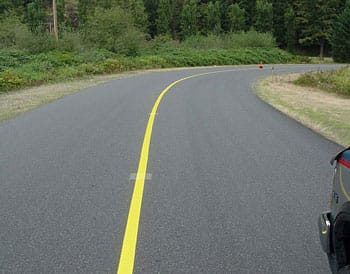
Broken Lines
Broken lines can also be used for roadway division in places where passing or crossing the line does not affect personal or public safety or to minimize costs while still defining driving lanes.
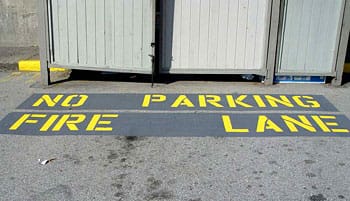
Fire Lanes
Fire Lanes are used in areas where parking can impede the ability of rescue vehicles to accomplish the task of saving lives or property. Usually found around buildings or in laneways, the fire lane is all about safety.
No Parking Areas
No parking areas designate where vehicles should not come to rest due to either safety, practicality or by-law reasons. The no parking area can designated in various ways but usually defined by cautionary yellow text.
Drive-Thru Lanes
The Drive-Thru Lane was developed as a means to direct traffic by following a designated path through a site. Whether it be for a fast food service , bank machine, or some other purpose, the Drive-Thru Lane serves an important function. It clearly defines a path through the site to minimize the traffic jams while maximizing vehicle and pedestrian safety.
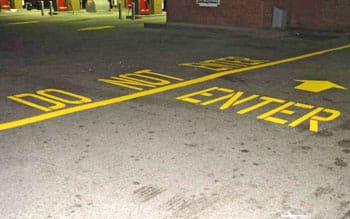
Stop Bar
The stop bar clearly designates the area where vehicles should stop. This marking is usually accompanied by either a stop sign on a pole or building or by a stop stencil painted on the road surface, usually just in front of the stop bar itself. The stop bar serves as an important part of any site that includes intersections where collisions may occur without one.
One Way Markings
One way markings are used for many applications but have one common theme, to direct traffic in a singular direction. This may be used at exits or exits, in a drive-thru lane, in an alley or possibly in a school area. The one way arrow may stand alone due to it’s universal definition or may have the ONE WAY sign included or as a painted stencil on the road surface.
Enter / Exit
Enter / Exit markings clearly define the entrances and exits to sites. The stencils may also be coupled with the arrows or maybe reworded as In / Out but the chief purpose remains the same, to provide visibility for the motorist as to the location of the entrances and exits. The marking comes in a variety of sizes and can be painted in a variety of colors but the standards are white and yellow.
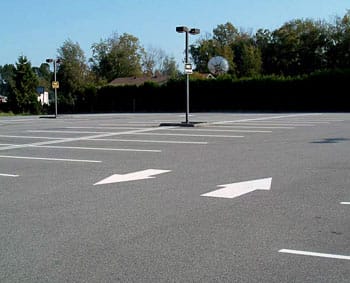
Directional Arrows
Directional arrows are used to indicate traffic flow. This symbol may be used in conjunction with one way stencils or as a stand alone entity. It clearly marks the direction that traffic flows in and helps increase both safety and awareness.
Why Choose Iconic?
- Excellent workmanship by professional line painting personnel.
- State-of-the-art airless line striping equipment, regularly serviced and maintained for optimum performance.
We use premium Canadian paint products from Ennis Flint, supplied by Cloverdale Paint—both proudly Canadian companies. Our paints meet MOT requirements and are applied unthinned (unlike some of our competitors), in full compliance with industry standards.
- We strive to do the best job in the business at a competitive price!
- $5M liability insurance.
- Fully covered by WCB WorkSafeBC.
Contact Us Today!
To get in touch with us, or to get a free estimate, please fill in the following form: